5 min read
Live
2025
Hate Speech Detector
High-precision text analysis pipeline exploring responsible AI, semantic reasoning, and operational moderation at scale.
NLPMachine LearningPythonReactTransformers
Overview
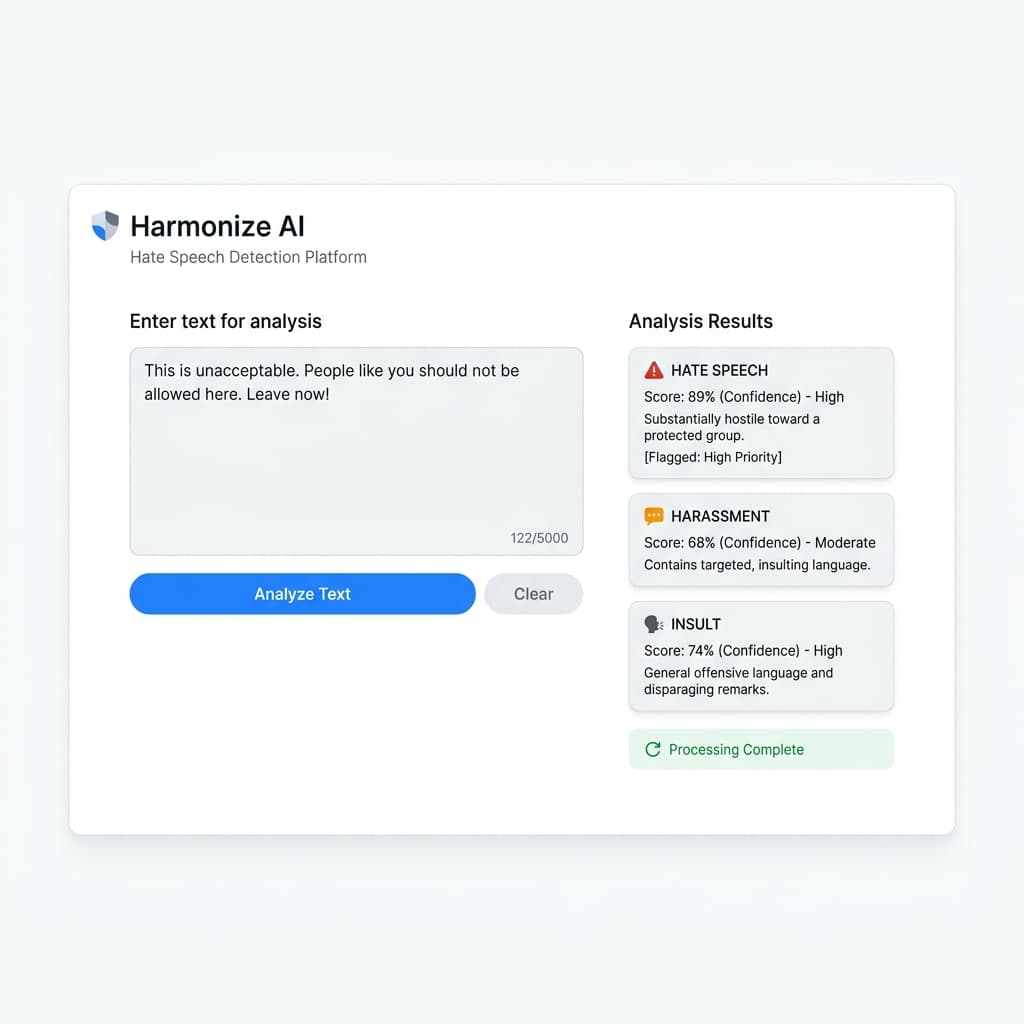
Online toxicity remains a critical challenge in digital communication. Hate Speech Detector was built as a real-time text analysis pipeline that combines transformer-based NLP models with a clean, accessible interface to identify and classify harmful language patterns.
Beyond a simple classification tool, this project is an exploration into Responsible AI and the operational challenges of building automated systems that must navigate the extreme nuance of human language.
Problem & Motivation
Manual moderation is fundamentally unscalable, yet traditional keyword-based filters are easily bypassed by sarcasm, coded language, and evolving slang. These rigid systems often fail because they lack semantic context—the ability to understand how a word is being used, not just that it exists.
The challenge was to build a system that understands intent rather than just matching characters, requiring a move from simplistic moderation to sophisticated semantic reasoning.
System Architecture
The system follows a clean client-server architecture designed for high-throughput inference and modular refinement.
The inference pipeline consists of a BERT-based transformer encoder fine-tuned on specialized toxicity datasets. The architecture is designed to isolate the pre-processing (normalization), inference (classification), and post-processing (confidence calibration) layers.
By separating the inference engine from the interaction layer, we've ensured that the system remains maintainable as new moderation models are introduced. This modularity allows us to update the "detection logic" without redesigning the entire moderation workflow.
Workflow & Process
Developing a responsible AI system requires a strict focus on validation and refinement. Our process emphasizes:
- Dataset Curation: Filtering and balancing training data to ensure the model isn't biased toward specific demographic markers.
- Fine-Tuning Cycles: Iteratively refining the transformer weights to capture subtle sarcasm and reclaimed language.
- Human-in-the-Loop Validation: Testing the system's "edge case" responses against human moderation intuition to identify semantic gaps.
Technical Decisions
We chose a fine-tuned specialized transformer (BERT) over a general-purpose LLM to achieve a superior balance between inference speed and domain-specific accuracy.
Explainability Strategy
To build user trust, the system implements an attention-mapping layer. By visualizing which tokens contributed most to a classification score, the system provides transparent reasoning for its moderation decisions, moving away from "Black Box" AI.
Simple model outputs often overstate certainty. We implemented temperature scaling to calibrate confidence scores, ensuring the system communicates its own uncertainty when faced with ambiguous language.
Tradeoffs & Rationale
We prioritized real-time responsiveness for the interface, which led us to use a more compact model architecture. While a larger ensemble might provide slightly more nuance, the sub-second inference time was deemed critical for a "calm" user experience.
In a responsible AI system, the tradeoff between safety and freedom is paramount. We tuned our classification thresholds to be "conservatively protective," prioritizing the reduction of toxic noise while acknowledging the potential for occasional false positives in highly ambiguous contexts.
Operational Constraints
Operating a transformer model in a real-time web environment introduces significant latency constraints. We manage this through aggressive model optimization and efficient tokenization pipelines.
As the volume of text increases, the computational cost of transformer inference scales linearly. Future iterations will require more sophisticated load balancing across multiple inference workers to maintain the current performance standards.
Iteration & Evolution
The architecture matured from a simple binary classifier into a multi-label reasoning engine.
- Phase 1: Keyword-based filters (limited).
- Phase 2: Single-label BERT classification (improved).
- Phase 3: Multi-label semantic analysis with attention-mapping (current), allowing for a more granular understanding of toxicity types (e.g., identity-based vs. general aggression).
Lessons & Reflections
Building this project reinforced that systems thinking is as important as model training.
- Context is everything: A keyword that is toxic in one setting may be neutral in another.
- Explainability is essential: AI moderation must be transparent to be legitimate.
- Reliability is a baseline: A moderation system that is "mostly" accurate is often worse than no system at all.
Research Foundation
Validating Semantic Precision
The reliability of this detection system is rooted in experimental foundations developed within the Lab:
- Semantic Search Playground: Research into embedding drift and semantic ambiguity helped us refine the confidence thresholds required for accurate moderation in non-deterministic contexts.
- Content Pipeline Agent: The "Refine & Validate" loops established in our agentic pipelines provided the operational model for our human-in-the-loop review interface.
Future Direction
The future of the Hate Speech Detector lies in contextual reasoning improvements and deeper ecosystem integration.
- Cross-Lingual Detection: Expanding the semantic models to understand toxicity across multiple languages and cultural contexts.
- Ecosystem Integration: Linking the moderation engine into other projects (like the Lab or Writing comments) to provide a unified safety layer for the entire Suraj Kumar platform.
Related Lab Experiment
Launch Experiment→AI Code Review Bot
A GitHub-integrated bot that provides contextual code review feedback using static analysis and LLMs.
Related Lab Experiment
Launch Experiment→Monetization Systems
Exploring how monetization systems interact with performance, UX, and ecosystem design in a premium environment.