5 min read
•Last Editorial Refinement:
A conversational AI agent exploring emotional intent mapping and intent-based retrieval within a calm discovery interface.
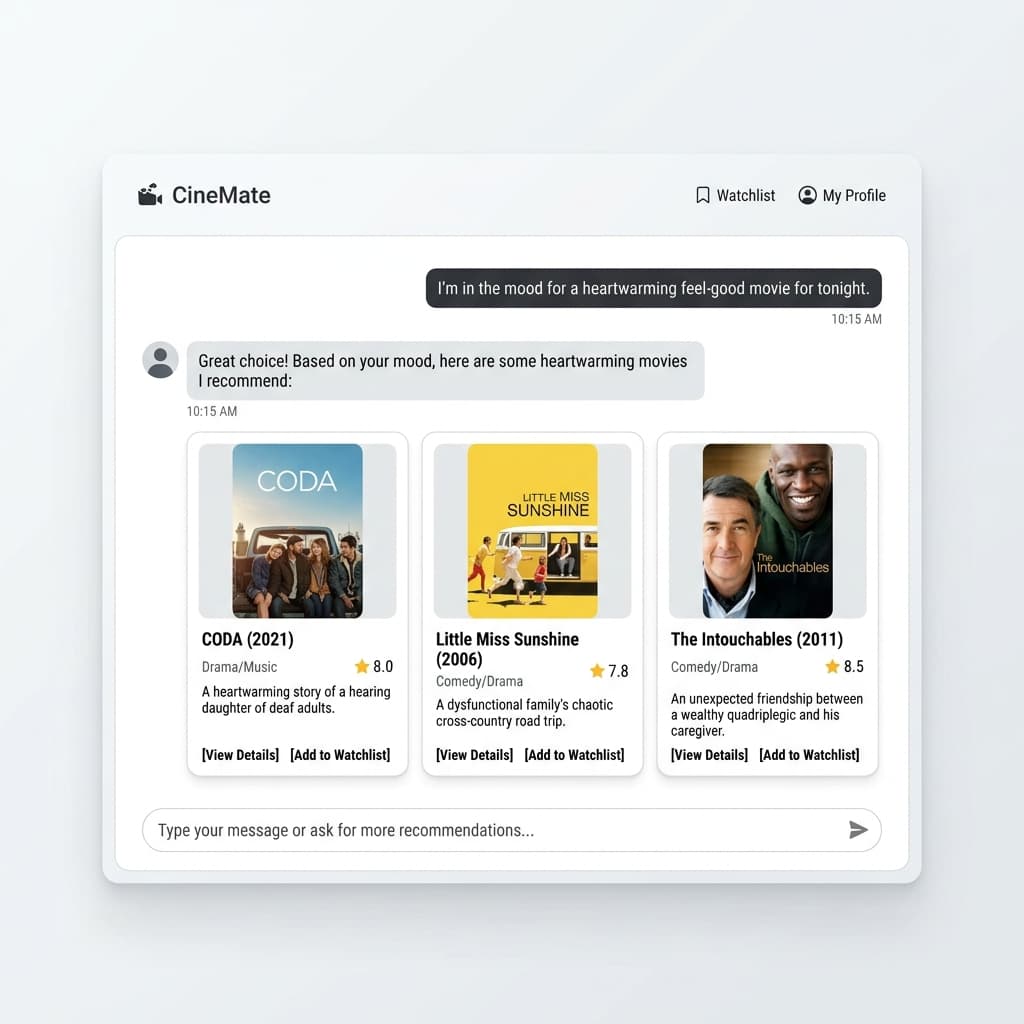
Choosing what to watch shouldn't feel like a chore. Mood-Based Movie Recommendation Agent is a conversational AI system that understands emotional context through natural dialogue, surfacing thoughtful, personalized recommendations based on how you feel right now.
In an ecosystem built on calm interaction, this project serves as a primary example of how AI can simplify complex discovery processes by focusing on human emotional intent rather than cold algorithmic history.
Traditional recommendation systems rely heavily on viewing history and explicit ratings. However, what you want to watch on a rainy Sunday afternoon is fundamentally different from what you'd enjoy on a high-energy Friday night.
Most entertainment platforms suffer from "Discovery Overload"—presenting endless grids of content that require significant cognitive effort to navigate. There is a fundamental mismatch between the rigid genre filters of today's algorithms and the fluid emotional intent of the viewer.
The system is built as a conversational bridge between raw human emotion and structured film metadata.
The architecture prioritizes the separation of interaction and recommendation logic. The conversational interface (Next.js) handles the nuance of natural language, while the underlying reasoning layer (LLM) performs the emotional-to-semantic mapping required to query movie databases effectively.
The pipeline follows a structured path: Mood Extraction → Emotional-to-Genre Mapping → Intelligent Filtering → Ranked Presentation. By modularizing these steps, we can refine the agent's "emotional intelligence" without disrupting the data retrieval systems.
Our iteration cycle focused heavily on conversational refinement and UX testing:
We made a deliberate choice to prioritize conversational simplicity over a dense feature set.
The agent is intentionally constrained to recommend only 3–5 carefully selected films. This reduces decision fatigue and reinforces the "curated quality" philosophy of the ecosystem, ensuring the user feels supported rather than overwhelmed.
We treated the system prompt not just as a technical instruction, but as the core product definition. The way the agent asks follow-up questions and presents results is as critical as the underlying model's movie knowledge.
We sacrificed the ability to provide "exhaustive" lists for conversational clarity. While some users might want to see 50 options, we believe a calm experience is better served by a few highly accurate suggestions that respect the user's attention.
By choosing a specialized conversational flow, we limited the agent's ability to handle general-purpose queries. This was a strategic choice to ensure the system remained optimized for its primary purpose: emotional movie discovery.
Human input is often vague or contradictory. The system must gracefully handle "ambiguous emotional states" by asking clarifying questions without becoming intrusive or annoying.
As the depth of the conversation increases, so does the token cost and latency. We manage this through careful state management and concise prompt engineering to ensure the experience remains responsive and cost-effective.
The interaction model evolved through several simplifications:
This project provided a deep masterclass in AI-assisted product thinking:
The core reasoning engine of this agent was prototyped and validated through foundational Lab research:
The future of the Mood Movie Agent involves deeper personalization and ecosystem integration:
An interactive system for exploring vector embeddings and semantic similarity across different text inputs.